
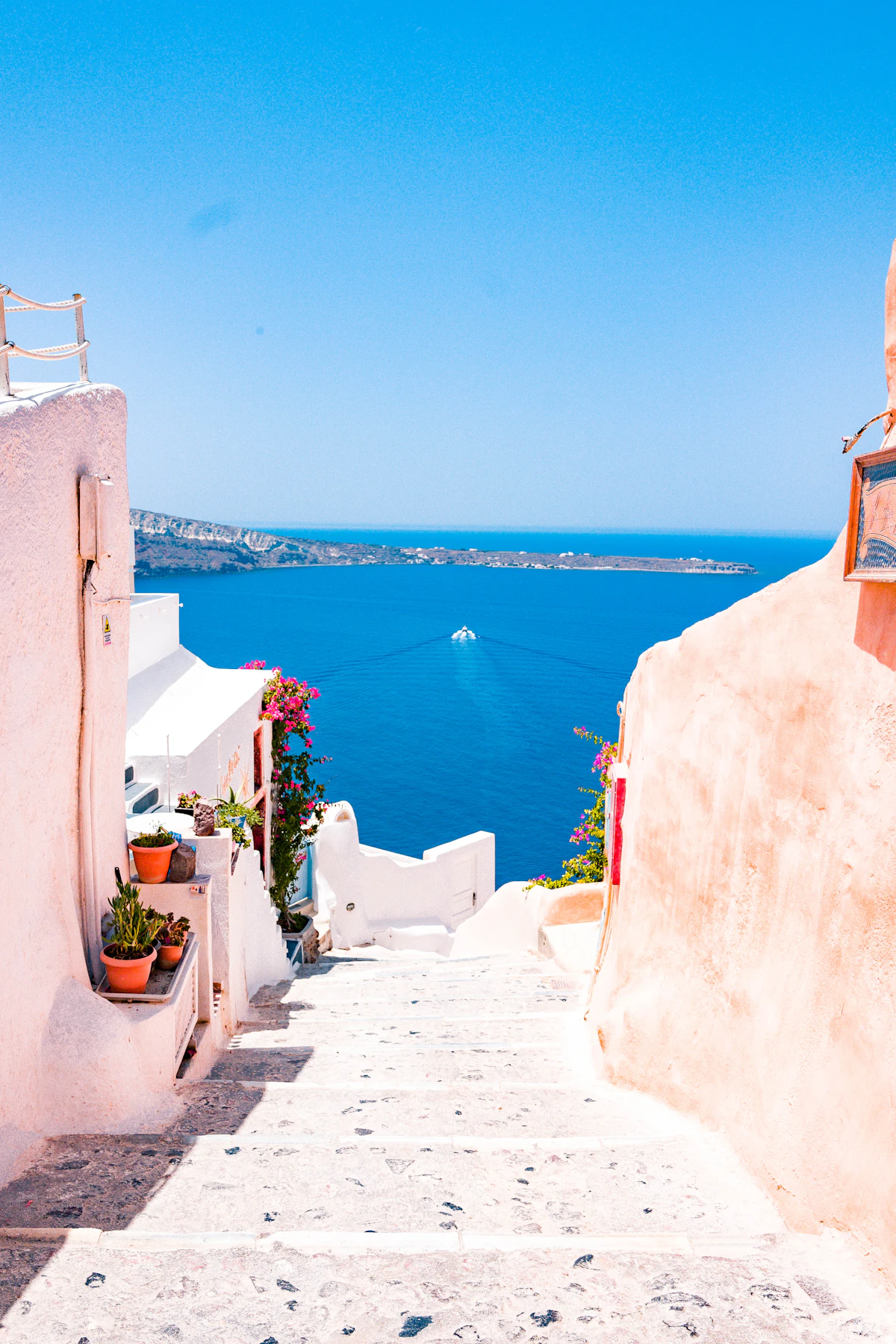
The Aegean Sea has a specific rhythm—a crisp, salty breeze that carries the scent of wild thyme and dry summer grass. Scurrying past commercial port cities, we discover the beauty of footpaths built by ancient shepherds.
Hiking these unmapped trails reveals a Mediterranean untouched by mass tourism. Here, whitewashed family chapels sit silently on rocky cliffs overlooking an infinite horizon of deep sapphire water.
We encourage taking a slow approach: pack a simple lunch of ripe tomatoes, sheep’s cheese, and local olives, and spend your afternoons swimming in isolated volcanic coves where the only sound is the rhythmic lap of waves.
To travel slowly is to understand that the destination is merely a canvas upon which our focused attention paints its memories. In our modern quest for efficiency, we have turned travel into a series of checklists—monuments to photograph, famous restaurants to book, and flights to catch with breathless haste. But this consumerist approach to travel often leaves us more exhausted than when we departed, with only a collection of digital files to show for our efforts. Slow travel, however, is a deliberate posture of curiosity and receptivity. It is the choice to stay in one place long enough to learn the direction of the morning wind, to recognize the face of the local baker, and to let the local cadence of life slowly alter your own breathing. It is about understanding that the magic of a place is never found in the crowded tourist squares, but in the quiet, unmapped alleyways where daily life unfolds in its beautiful, ordinary simplicity.
The landscapes we encounter have a unique way of reflecting our internal states. When we stand before the vast, dramatic basalt plains of Iceland, or hike along the high, rugged cliffs of the Aegean Sea, we are reminded of our beautiful, small place in the grand design of the cosmos. The sheer scale of ancient glaciers, volcanic stone, and boundless ocean horizons acts as a natural corrective to our modern anxieties. Our temporary daily worries, which feel so massive and consuming within the walls of our offices, are gently dissolved by the silent, ancient patience of the earth. We realize that we are part of a continuous, living tapestry that has existed for millions of years, and this realization brings a profound sense of comfort, grounding, and perspective that lingers long after we return home.
Let us reflect on the ancient, mindful customs that have been preserved across generations in slow-paced cultures. In Japan, the tea ceremony, or ‘Chado,’ is a lifetime path of discipline dedicated to the simple act of preparing and serving a cup of green tea. Every movement—from the way the wooden water ladle is held to the precise angle at which the ceramic bowl is presented—is performed with absolute focus and reverent grace. This practice teaches us that there are no ordinary moments; every simple action, when performed with complete presence, can be elevated into a beautiful, sacred art. When we travel with an open, respectful heart, we carry these slow habits back with us, integrating them into our domestic routines as permanent anchors of peace.
The sensory memory of a slow journey is far more durable than any commercial souvenir. Long after you leave the historic food passages of Bologna, you will still be able to recall the rich, warm scent of simmering ragù drifting through the medieval stone porticoes, or the vibrant, melodic chatter of family merchants arguing over the quality of fresh porcini mushrooms. These memories are captured not through our camera lenses, but through our fully engaged senses. By choosing to walk instead of drive, to sit on a wooden bench for two hours doing nothing but observing, and to engage in quiet, slow-tempo conversations with the people we meet, we write these landscapes directly into our souls.
Ultimately, the true destination of any travel is not a new geographic coordinate, but a new way of seeing. As Aria Vance, I have wandered through hidden valleys and stood on quiet alpine summits, and in every place, I have found that the most restorative journeys are those that guide us back to ourselves. By traveling without haste, we allow our modern mental armor to soften, opening ourselves to the quiet beauty and authentic wonder of our world. We return home not with a suitcase full of transient novelties, but with a lighter step, a wider perspective, and a renewed commitment to cultivating peace in our everyday lives.
As we reflect deeply on the themes discussed in “Salt & Stone: Exploring the Uncharted Coastal Paths of the Aegean”, we are reminded that slow living is not about doing everything at a crawl, but about doing everything at the correct tempo. It is about understanding that the quality of our attention defines the quality of our lives. When we choose to read with balanced depth, appreciate quiet beauty, and seek authentic perspective, we build a thoughtful sanctuary within ourselves. Whether through the garments we choose to wear, the daily routines we establish, the paths we travel, or the self-care rituals we practice, we can always choose to return to a place of centered clarity and wonder. Let this be your invitation to pause, breathe, and appreciate the magnificent simplicity of the present moment.

Aria Vance
Aria is a vintage curator and thrifting expert with over a decade of experience sourcing designer silhouettes on a budget. She believes every piece of pre-loved clothing deserves a second story.